
Growth Hormone Secretagogue Peptides: What the Published Research Describes
Research Use Only. For laboratory research use only — not for human or animal consumption.
Research Use Only. All Premier Research products are supplied strictly for in vitro laboratory investigation. Not intended for human or veterinary consumption, therapeutic use, dietary supplementation, or clinical application. Not FDA-approved.
What does the published literature actually say about how growth hormone secretagogue peptides work at the receptor level? This article summarizes the classification, receptor pharmacology, and study designs reported for GHRP-class and GHRH-analog peptides, and separates what has been measured in the literature from what has not.
In This Article
- What Growth Hormone Secretagogues Are Classified As
- How GHRP-Class Peptides Engage the Ghrelin Receptor
- How GHRH-Analog Peptides Differ From GHRP-Class Peptides
- What Published Studies Have Measured in GHRP and GHRH Research
- How Researchers Confirm Identity and Purity Before Using Secretagogue Peptides in Assays
- How Lyophilized Secretagogue Peptides Are Reported to Degrade
- FAQ
What Growth Hormone Secretagogues Are Classified As
In the pharmacology literature, a growth hormone secretagogue (GHS) is an umbrella term for any compound reported to stimulate growth hormone release from the pituitary. Ishida et al., 2020, describe the category as encompassing several structurally distinct families rather than a single mechanism.
Two peptide families dominate the published literature:
- GHRP-class peptides, reported to act on the ghrelin receptor.
- GHRH-analog peptides, reported to act on the separate growth-hormone-releasing-hormone receptor.
The class also includes small-molecule oral secretagogues discussed in the pharmacology literature, though the catalog compounds addressed in this article are peptides.
The term "growth hormone secretagogue" describes a receptor pharmacology category, not one mechanism. Two structurally unrelated peptide families can both carry the label while engaging entirely different receptors.
How GHRP-Class Peptides Engage the Ghrelin Receptor
Sigalos and Modi, 2017, report that GHRP-class peptides act as agonists at GHSR-1a, the ghrelin receptor. The review describes a signaling sequence that begins with receptor activation, proceeds through downstream phospholipase C signaling, and is associated with pulsatile growth hormone release from somatotrophs, the pituitary cells responsible for growth hormone secretion.
Berlanga-Acosta et al., 2017, characterized the synthetic origin of GHRP-class compounds and their receptor-binding behavior in vitro and in rodent models. The authors described these peptides as products of structure-activity work aimed at mimicking ghrelin's action at GHSR-1a rather than as naturally occurring hormones themselves.
A short note on scope: the review literature describes what GHSR-1a activation does in assay systems and animal models. It does not describe outcomes for any individual context, and this article does not extend the findings beyond what the cited authors reported.
How GHRH-Analog Peptides Differ From GHRP-Class Peptides
GHRH-analog peptides are reported to act on the distinct GHRH receptor rather than GHSR-1a, per Ishida et al., 2020. The two receptor systems are structurally and pharmacologically separate, even though both are described in the literature as converging on growth hormone pulsatility through different upstream signals.
The table below summarizes the distinction as reported across the cited reviews.
| Characteristic | GHRP-Class Peptides | GHRH-Analog Peptides |
|---|---|---|
| Receptor target | GHSR-1a (ghrelin receptor) | GHRH receptor |
| Reported signaling pathway | Phospholipase C cascade, per Sigalos and Modi, 2017 | GHRH-receptor-mediated cAMP signaling, per Ishida et al., 2020 |
| Structural origin | Synthetic peptides designed to mimic ghrelin, per Berlanga-Acosta et al., 2017 | Analogs of endogenous GHRH sequence, per Ishida et al., 2020 |
| Study designs reported | In vitro and rodent receptor-binding assays | Human and animal research contexts reviewed across multiple studies |
In plain terms: GHRP-class and GHRH-analog peptides are not two versions of the same compound. They are two separate keys shaped for two separate locks, and the literature reports them as engaging different signaling machinery upstream of growth hormone release.
What Published Studies Have Measured in GHRP and GHRH Research
Sigalos and Modi, 2017, reviewed reported outcomes in growth-velocity, lean-mass, and bone-density research contexts across a mix of human and animal study designs. The review summarizes what those studies measured; it does not generalize those measurements to any individual use case, and neither does this article.
Berlanga-Acosta et al., 2017, described in vitro and rodent assay literature specific to GHRP-class receptor pharmacology, including binding characterization and downstream signaling markers observed in cell and animal models.
It is worth stating plainly where the literature is thin. Several members of the GHS class have only early-stage rodent or in vitro characterization published, according to the cited reviews; depth of evidence varies considerably from one specific peptide to the next.
A study measures what it measures. A receptor-binding assay reports a binding affinity; a rodent growth-velocity study reports a growth-velocity measurement in that species under that design. Neither finding is interchangeable with the other, and neither is a statement about any other context.
How Researchers Confirm Identity and Purity Before Using Secretagogue Peptides in Assays
Before any peptide material enters an assay, the standard reported practice in the literature is to confirm both purity and identity independently.
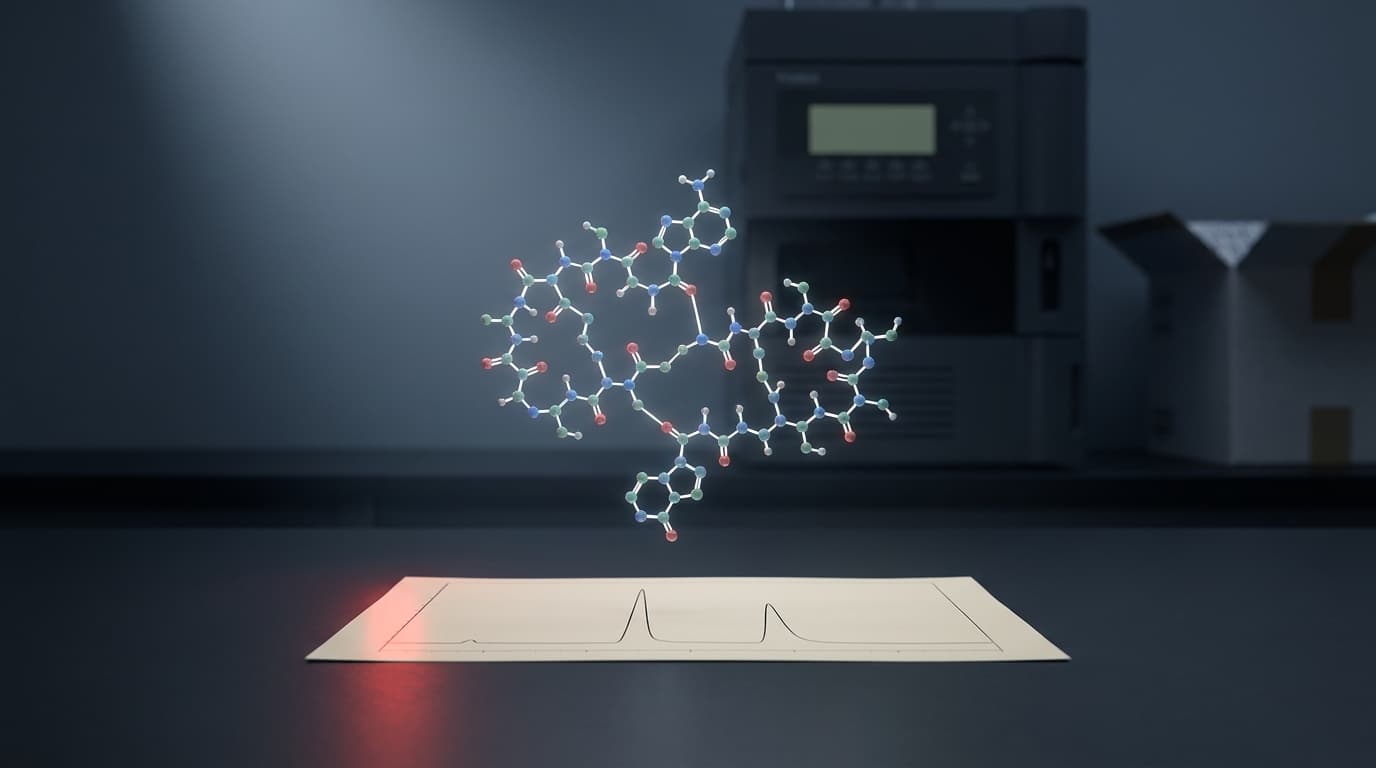
RP-HPLC (reverse-phase high-performance liquid chromatography) is the standard reported method for peptide purity assessment. Kaiser and Ryan, 2008, describe purity as an area-percent value: the proportion of the chromatogram's total peak area attributable to the main peptide peak versus impurity peaks. Identity is a separate question from purity, and the literature addresses it with mass spectrometry: ESI-MS and MALDI-TOF-MS are the two methods routinely reported for confirming that a peptide's measured mass matches its sequence-derived theoretical mass.
Premier Research applies both methods to every catalog compound. Each peptide is synthesized to at least 99% purity by RP-HPLC, with identity confirmed by ESI or MALDI-TOF mass spectrometry, and analytics are run by a third-party accredited lab. The batch-level certificate of analysis is published at /coa.
When reviewing a certificate of analysis for any research peptide, a bench scientist should look for:
- A purity percentage reported by RP-HPLC, with the method and column conditions referenced.
- A mass-spec identity match showing measured mass against theoretical mass.
- A lot number that ties the document to the physical material in hand.
- A method reference identifying the lab and technique used for each measurement.
A COA without all four of these is missing information, not just formatting.
How Lyophilized Secretagogue Peptides Are Reported to Degrade
Lyophilized peptides do not sit inert indefinitely. Manning et al., 2010, describe several reported degradation pathways for lyophilized peptide material: deamidation, oxidation, disulfide scrambling, diketopiperazine formation, and aggregation on rehydration.
The same formulation literature reports that these degradation kinetics are slowest when material is kept at -20°C or colder in sealed containers with desiccant present. Karl Fischer titration is the standard method reported for quantifying residual moisture, and the cited literature associates sub-3% moisture content with slower degradation kinetics across these pathways.
Premier Research's storage chain follows this reasoning directly: material is held at -20°C or colder in sealed foil pouches with desiccant from synthesis through fulfillment, screened by Karl Fischer titration for water content and by residual-solvent testing, with non-conforming lots quarantined rather than shipped. The batch documentation reflecting this chain is published alongside the purity and identity data at /coa.
A related companion post walks through the mechanics of lyophilization and cold-chain handling in more depth: see /blog/how-lyophilized-peptides-are-stored-and-shipped.
FAQ
What is a growth hormone secretagogue peptide?
In the pharmacology literature, a growth hormone secretagogue is a compound that stimulates growth hormone release from the pituitary. Published reviews, including Ishida et al., 2020, classify GHRP-class peptides as ghrelin-receptor agonists and GHRH-analog peptides as GHRH-receptor agonists, two distinct structural families with different reported signaling pathways.
How do GHRP-class peptides differ from GHRH-analog peptides?
GHRP-class peptides are reported to act on the ghrelin receptor (GHSR-1a), while GHRH-analog peptides act on the separate GHRH receptor, per Sigalos and Modi, 2017, and Ishida et al., 2020. The two classes have distinct structural origins and are described in the literature as engaging different upstream signaling cascades that converge on growth hormone pulsatility.
What methods confirm the identity and purity of a secretagogue peptide?
Reverse-phase HPLC with UV detection is the standard reported method for purity, expressed as an area-percent value, per Kaiser and Ryan, 2008. Identity is confirmed by ESI-MS or MALDI-TOF mass spectrometry against the sequence-derived theoretical mass, consistent with ICH Q6A guidance and the peer-reviewed mass-spectrometry literature.
How should lyophilized secretagogue peptide material be stored?
The formulation literature, including Manning et al., 2010, reports that lyophilized peptides degrade through deamidation, oxidation, and aggregation pathways, and that these kinetics are slowest when material is kept at -20°C or colder in sealed containers with desiccant. Karl Fischer titration is the standard reported method for confirming low residual moisture.
Is the research on growth hormone secretagogue peptides limited to animal studies?
No; the cited reviews describe a mix of study designs. Sigalos and Modi, 2017, summarized human and animal research contexts, while Berlanga-Acosta et al., 2017, focused on in vitro and rodent assay characterization of GHRP-class receptor pharmacology. Evidence depth varies by specific peptide and should be read study by study.
Research Materials
Premier Research publishes batch-level certificates of analysis, including RP-HPLC purity and mass-spec identity data, for its GHRP-class and GHRH-analog catalog compounds at /coa. All materials are labeled research-use only and are not evaluated by the FDA.
Frequently Asked Questions
What is a growth hormone secretagogue peptide?
In the pharmacology literature, a growth hormain secretagogue is a compound that stimulates growth hormone release from the pituitary. Published reviews, including Ishida et al., 2020, classify GHRP-class peptides as ghrelin-receptor agonists and GHRH-analog peptides as GHRH-receptor agonists, two distinct structural families with different reported signaling pathways.
How do GHRP-class peptides differ from GHRH-analog peptides?
GHRP-class peptides are reported to act on the ghrelin receptor (GHSR-1a), while GHRH-analog peptides act on the separate GHRH receptor, per Sigalos and Modi, 2017, and Ishida et al., 2020. The two classes have distinct structural origins and are described in the literature as engaging different upstream signaling cascades that converge on growth hormone pulsatility.
What methods confirm the identity and purity of a secretagogue peptide?
Reverse-phase HPLC with UV detection is the standard reported method for purity, expressed as an area-percent value, per Kaiser and Ryan, 2008. Identity is confirmed by ESI-MS or MALDI-TOF mass spectrometry against the sequence-derived theoretical mass, per the ICH Q6A guideline and the peer-reviewed mass-spectrometry literature.
How should lyophilized secretagogue peptide material be stored?
The formulation literature, including Manning et al., 2010, reports that lyophilized peptides degrade through deamidation, oxidation, and aggregation pathways, and that these kinetics are slowest when material is kept at -20C or colder in sealed containers with desiccant. Karl Fischer titration is the standard reported method for confirming low residual moisture.
Is the research on growth hormone secretagogue peptides limited to animal studies?
No; the cited reviews describe a mix of study designs. Sigalos and Modi, 2017, summarized human and animal research contexts, while Berlanga-Acosta et al., 2017, focused on in vitro and rodent assay characterization of GHRP-class receptor pharmacology. Evidence depth varies by specific peptide and should be read study by study.