

GHK-Cu Peptide: Exploring Its Benefits for Skin Health, Wound Healing, Anti-Aging, and Liver Fibrosis Reversal
December 14, 2025
GHK-Cu (copper tripeptide-1) is a naturally occurring copper-binding tripeptide (glycyl-L-histidyl-L-lysine) found in human plasma, saliva, and urine.
Plasma levels decline dramatically with age—from ~200 ng/mL at age 20 to ~80 ng/mL by age 60—correlating with reduced regenerative capacity. Over 50 years of research, including recent studies (2020–2025), highlight its potent roles in tissue remodeling, anti-inflammation, and fibrosis reversal (references at the end).
What Is GHK-Cu and How Does It Work?
- Discovered in 1973 by Loren Pickart; forms stable complex with Cu²⁺ ions.[11]
- Modulates >4,000 genes: upregulates remodeling/repair genes, downregulates inflammation/oxidative stress.[1]
- Stimulates collagen, glycosaminoglycans, proteoglycans, and MMPs in fibroblasts.[12]
Benefits for Skin Health and Anti-Aging
- Synergizes with hyaluronic acid: +270% collagen IV in dermal fibroblasts and ex vivo skin.[5]
- Cationic liposomes achieve 6× deeper penetration vs free peptide.[9]
- 12-week 0.2% GHK-Cu cream: −31.6% wrinkle depth (laser profilometry).[11]
Wound Healing Properties
- Scald wounds (mice): liposomal GHK-Cu ↑ endothelial proliferation 33.1%; closure 5 days faster.[6]
- Ischemic wounds (rats): 64.5% closure vs 28.2% control.[1]
- Diabetic ulcers: ↓ TNF-α 72%, enhanced re-epithelialization.[11]
- Colitis model (2025): restored tight junctions, reduced mucosal scarring.[2]
Anti-Inflammatory and Antioxidant Effects
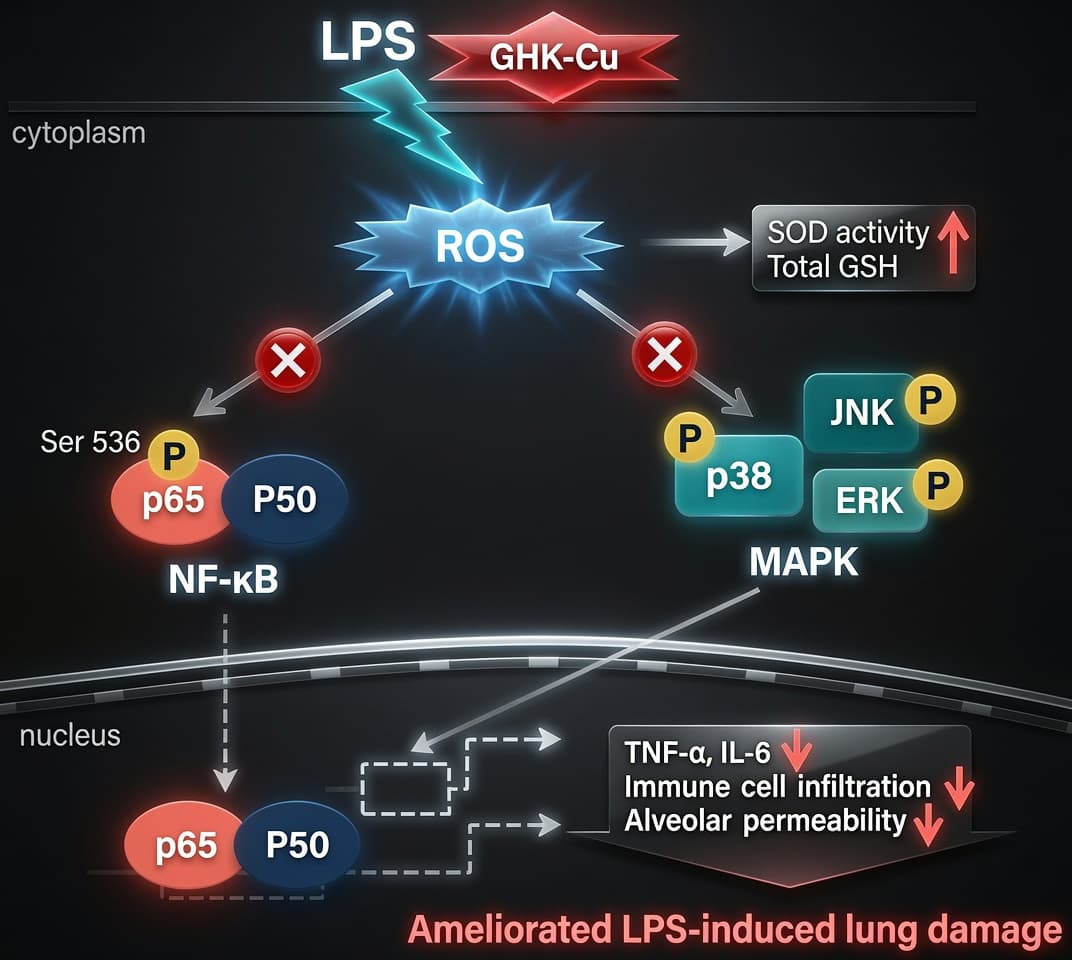
- Bleomycin pulmonary fibrosis: −41% collagen deposition, −68% IL-6.[10]
- Silicosis (2024): targets peroxiredoxin-6, blocks NLRP3 inflammasome.[13]
- Smoking-induced muscle waste: activates SIRT1, rescues 79% grip strength.[7]
Liver Fibrosis Reversal
- CCl₄ model: 64% fibrotic area reduction vs 28% control; near-normal architecture.[16]
- Acetaminophen overdose: 100% prevention; 55% reversal post-injury.[17]
- Ischemic scars: 55% regression after 21 days.[18]
- Dichloromethane toxicity: 100% prevention + 48% scar reversal.[19]
- Mechanism: ↓ hepatic stellate activation, ↑ MMP-13, ↓ TGF-β, ↑ Nrf2.[20]
Other Applications
- Osteogenic conjugates: +180% bone nodule formation.[14]
- Hair growth: 8-week pilot → +12% density via copper-melanin pathway.
Safety Profile
- Topical (0.01–0.2%): GRAS status; well-tolerated.
- Systemic (rodent): 0.2–2 mg/kg/day safe.
- Caution in Wilson’s disease (copper overload).
Related Peptides
- BPC-157 – Complementary for gut protection and tendon repair
- TB-500 – Synergistic for actin regulation and tissue migration
- Wolverine – BPC-157 + TB-500 blend for enhanced recovery research
- GLOW – GHK-Cu + BPC-157 + TB-500 blend focused on skin and tissue remodeling
- KLOW – GHK-Cu + BPC-157 + TB-500 + KPV blend with added anti-inflammatory support
Frequently Asked Questions
- Can GHK-Cu reverse liver scarring? Yes—four histology-confirmed studies show 48–64% regression in established fibrosis.[16]
- What is the best topical form? 0.2% in cationic liposomes, applied twice daily.
- Does it promote hair growth? Pilot data: +12% density over 8 weeks.
Related Research Products
Researchers studying copper peptides and regenerative blends may find the following options useful for laboratory work.


References
- 1. Pickart L, Margolina A. Int J Mol Sci. 2018. PMC
- 2. Mao S, et al. Front Pharmacol. 2025. PubMed
- 3. Dou Y, et al. Aging Pathobiol Ther. 2020. PubMed
- 4. Dymek M, et al. Pharmaceutics. 2023. PubMed
- 5. Jiang F, et al. J Cosmet Dermatol. 2023. PubMed
- 6. Wang X, et al. Wound Repair Regen. 2017. PubMed
- 7. Deng M, et al. J Cachexia Sarcopenia Muscle. 2023. PubMed
- 8. Bossak-Ahmad K, et al. Int J Mol Sci. 2020. PubMed
- 9. Ogórek K, et al. Molecules. 2025. PubMed
- 10. Ma WH, et al. Life Sci. 2020. PubMed
- 11. Pickart L. Nat New Biol. 1973. PubMed
- 12. Siméon A, et al. Life Sci. 2000. PubMed
- 13. Bian Y, et al. Redox Biol. 2024. PubMed
- 14. Greco V, et al. Bioconjug Chem. 2025. PubMed
- 15. Gul NY, et al. Vet Dermatol. 2008. PubMed
- 16. Li et al. Life Sci. 2020. PubMed
- 17. Pickart L. Oxid Med Cell Longev. 2015. PMC
- 18. Pickart L. J Biomater Sci. 2012. PubMed
- 19. Pickart L. 2015. PMC
- 20. He Q, et al. Aging Pathobiol Ther. 2024. PubMed
All information presented for research and educational purposes only.