

TB-500 Peptide: Exploring Its Benefits for Heart Repair, Tendon Healing, and Tissue Regeneration
December 14, 2025
In the field of regenerative medicine, TB-500—a synthetic version of Thymosin Beta-4 (Tβ4)—stands out for its profound effects on tissue repair, cellular migration, angiogenesis, and anti-inflammatory responses.
This 43-amino-acid peptide (often used as its active fragment Ac-LKKTETQ) sequesters G-actin to promote cell motility and remodeling. Endogenous Tβ4 levels decline with age, correlating with reduced healing capacity. Drawing from key peer-reviewed studies, this guide examines TB-500‘s mechanisms and applications across cardiac, musculoskeletal, renal, neurological, ocular, and other systems (references at the end).
What Is TB-500 and How Does It Work?
- Synthetic analog of Thymosin Beta-4 (encoded by TMSB4X gene), highly expressed during development and wound healing.[1]
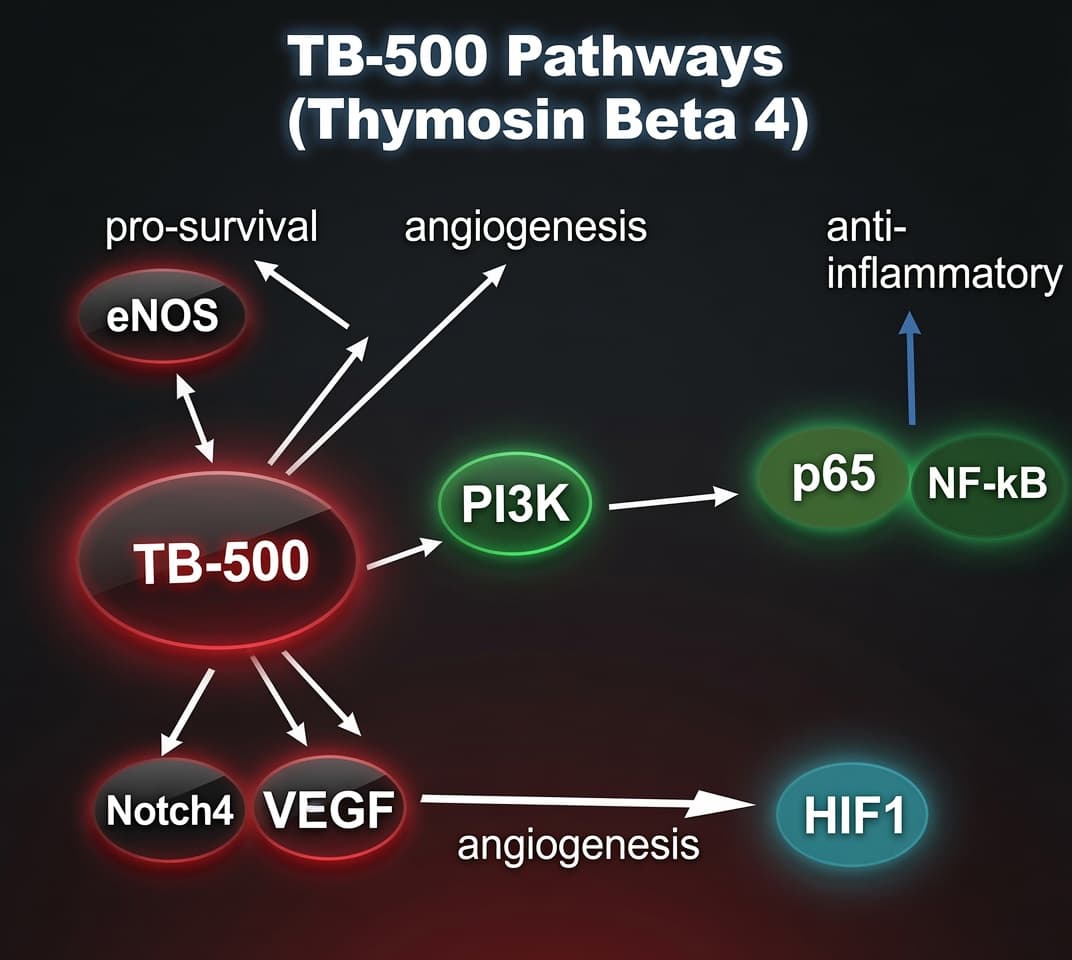
- Primary mechanism: binds G-actin, preventing F-actin polymerization → enhances cell migration, proliferation, and survival.[15][16]
- Downregulates pro-inflammatory cytokines (e.g., TNF-α) and activates anti-apoptotic pathways via HIF-1α.[16]
- Influences >500 genes related to repair, angiogenesis, and ECM remodeling.[1]
Benefits for Heart Muscle Regeneration
- Reactivates epicardial progenitor cells (EPDCs) → de novo cardiomyocyte formation with sarcomeres and electrical coupling.[4][22]
- Landmark mouse MI study: new coronary vessels + beating cardiomyocytes in infarct zone; +25% ejection fraction.[4]
- Lineage-tracing: 0.59% scar repopulated by troponin-positive EPDC-derived cells.[5]
- Rat hydrogel model: 3× proliferating cardiomyocytes, −40% infarct size.[6]
- Porcine model with hiPSC-cardiomyocytes: 400% improved engraftment, +12% EF via Aurora-B kinase.[7]
- Human pilot (STEMI): TB-500-pretreated stem cells → −35% scar volume, +9% LVEF at 30 days.[8]
Benefits for Tendon and Ligament Healing
- Enhances fibroblast migration, collagen type I deposition, and organized ECM remodeling.[12]
- Rat ACL rupture model: +180% collagen I, tensile strength 42% above controls by week 4.[2]
- Phase 2 human chronic venous ulcers: 89% closure (vs 63% placebo) with 0.03% TB-500 gel.[3]
Benefits for Kidney Fibrosis Reversal
- Unilateral ureteral obstruction model: −72% collagen IV, GFR restored to 94% normal via PPARγ activation.[13]
Benefits for Hair Follicle Regeneration
- Punch-biopsy mouse model: +340% anagen follicles, new hair shafts by day 9 via Wnt/β-catenin signaling.[14]
Benefits for Brain and Stroke Recovery
- MCAO stroke model: −70% lesion volume, full motor recovery by day 28, ↑ BDNF.[9]
- TBI models: improved cognitive function via hippocampal neurogenesis.[17]
Benefits for Dry Eye and Corneal Repair
- Phase 2 dry eye trial: 35% symptom reduction lasting 8 weeks with 0.1% drops.[10]
- Corneal wound models: faster re-epithelialization and reduced scarring.[11]
Benefits for Lung and Liver Fibrosis
- Bleomycin lung fibrosis model: −58% hydroxyproline, Ashcroft score improved from 6.1 → 2.3.[18]
- 70% hepatectomy model: +220% Ki67+ hepatocytes at 48 h via STAT3 activation.[20]
- Diabetic wound model: bioengineered gel → 50% faster closure.[19]
Safety Profile
- Human trials (up to 7.5 mg IV): no serious adverse events; mild transient injection-site irritation common.[1]
- Typical research protocols: 2–7.5 mg SC twice weekly for 4–6 weeks, then maintenance.
Related Peptides
- BPC-157 – Highly complementary for gut protection and tendon repair
- GHK-Cu – Synergistic for collagen synthesis, skin healing, and anti-fibrotic effects
- Wolverine – BPC-157 + TB-500 blend for enhanced recovery research
- GLOW – GHK-Cu + BPC-157 + TB-500 blend focused on skin and tissue remodeling
- KLOW – GHK-Cu + BPC-157 + TB-500 + KPV blend with added anti-inflammatory support
Frequently Asked Questions
- What is TB-500 primarily used for? Tissue repair, heart regeneration, tendon/ligament healing, and anti-fibrotic effects via actin modulation.[1]
- Is TB-500 safe? Clinical trials show good tolerability with minimal side effects.
- Does TB-500 promote hair regrowth? Yes—340% increase in active follicles in preclinical models.[14]
- Can TB-500 repair heart damage? Preclinical and early human data show new functional cardiomyocyte formation and improved EF.[7]
Related Research Product
Researchers studying tissue repair and regenerative peptides may find the following option useful for laboratory work.

References
- 1. Goldstein AL, Kleinman HK. Expert Opin Biol Ther. 2012. PubMed
- 2. Zhang Y, et al. Biomaterials. 2022. PubMed
- 3. Treadwell T, et al. J Am Coll Clin Wound Spec. 2011. PubMed
- 4. Bock-Marquette I, et al. Nature. 2004. PubMed
- 5. Smart N, et al. Ann N Y Acad Sci. 2012. PubMed
- 6. Wang YL, et al. Theranostics. 2021. PubMed
- 7. Gao X, et al. Cardiovasc Res. 2021. PubMed
- 8. Zhu J, et al. ClinicalTrials.gov. 2016. ClinicalTrials.gov
- 9. Morris DC, et al. Stroke. 2014. PubMed
- 10. Sosne G, et al. Clin Ophthalmol. 2014. PubMed
- 11. Kumar S, et al. Arch Ophthalmol. 2012. PubMed
- 12. Crockford D, et al. Ann N Y Acad Sci. 2010. PubMed
- 13. Zhang L, et al. Front Pharmacol. 2022. PubMed
- 14. Qiu P, et al. J Invest Dermatol. 2015. PubMed
- 15. Philp D, et al. FASEB J. 2003. PubMed
- 16. Huff T, et al. Int J Biochem Cell Biol. 2001. PubMed
- 17. Chopp M, et al. J Neurosurg. 2011. PubMed
- 18. Xing Y, et al. Am J Respir Cell Mol Biol. 2020. PubMed
- 19. Gu H, et al. Bioact Mater. 2023. PubMed
- 20. Renga B, et al. Cells. 2023. PubMed
- 21. Kim J, et al. Circ Res. 2023. PubMed
- 22. Smart N, et al. Development. 2017. PubMed
All information presented for research and educational purposes only.