

Retatrutide: The Triple Agonist Revolutionizing Metabolic Health Beyond Weight Loss
December 14, 2025
Retatrutide (LY3437943), a once-weekly injectable triple agonist targeting GLP-1, GIP, and glucagon receptors, has demonstrated exceptional results in phase 2 trials.
Key outcomes include up to 24.2% body weight loss (average ~58 lb over 48 weeks), HbA1c reductions of 2.02%, 82% relative liver fat clearance in MASLD, preservation of lean mass, +120 kcal/day energy expenditure, and major cardiovascular risk improvements. All data is drawn from published clinical trials and reviews (references at the end).
Molecular Design and Mechanism of Action
- 39-amino-acid peptide with C20 fatty diacid chain → half-life ~6 days for once-weekly SC dosing.[5]
- Balanced triple agonism: 8.9× potency at GIPR, 0.4× at GLP-1R, 0.3× at GCGR vs native ligands.[6]
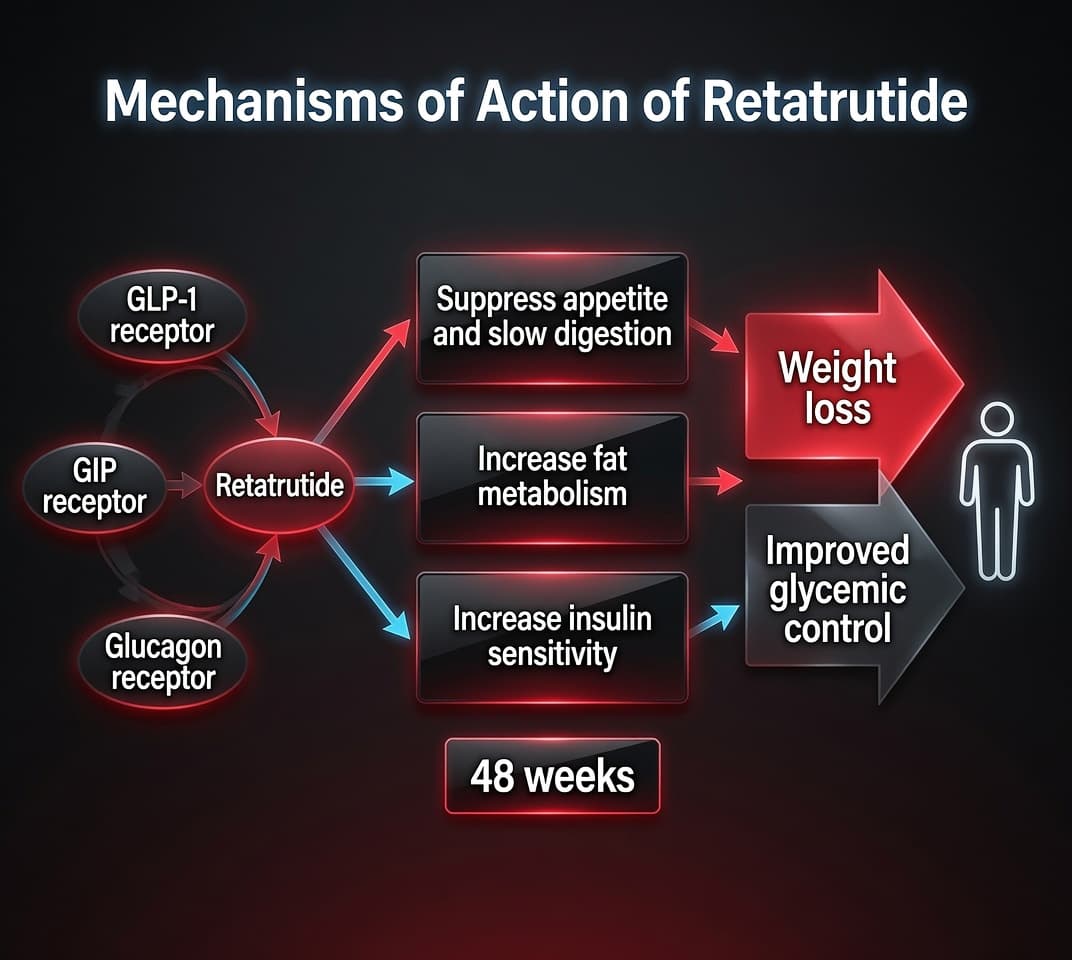
- GLP-1R: ↑ insulin secretion, ↓ glucagon, delayed gastric emptying, enhanced satiety.[16]
- GIPR: improved insulin sensitivity, healthy adipocyte function, muscle preservation.[25]
- GCGR: ↑ lipolysis, hepatic fat oxidation, resting energy expenditure.[7]
Phase 2 Evidence: Weight Loss and Glycemic Control
- Obesity trial (n=338): dose-dependent loss → −24.2% at 12 mg (48 weeks) vs −2.1% placebo; 83% achieved ≥15% loss.[1]
- T2D trial (n=281): −2.02% HbA1c at 12 mg (36 weeks); 41% reached normoglycemia.[2]
- −48% fasting insulin, −55% HOMA-IR indicating marked insulin sensitization.[2]
Liver Health and MASLD Benefits
- Substudy (n=98, ≥10% liver fat): −82% relative liver fat reduction at 24 weeks; 86% normalized (<5%).[3]
- ALT/AST −30–40%, K-18 −38%, Pro-C3 −26%; 89–93% normalization at 48 weeks.[15]
- Superior to tirzepatide (−45%) and semaglutide (−30%) due to glucagon-driven hepatic oxidation.[19]
Cardiovascular and Lipid Benefits
- Systolic BP −9.9 to −10.5 mmHg; triglycerides −25% to −40.6%; non-HDL −26.9%.[1]
- Small LDL particles −30%; ApoC-III −38%.[22]
- Phase 3 TRIUMPH trials evaluating long-term CV and renal outcomes.[11]
Muscle Preservation and Energy Expenditure
- DEXA: only 38% of weight loss from lean mass (stable absolute lean mass).[2]
- Resting energy expenditure ↑100–150 kcal/day via glucagon effects.[7]
- Adiponectin +47%, leptin −54%.[14]
Safety and Tolerability Profile
| Adverse Event | Retatrutide (All Doses) | Placebo |
|---|---|---|
| Any GI Event | 73% | 37% |
| Nausea | 42% | 12% |
| Vomiting | 24% | 5% |
| Heart Rate ↑ | +6.7 bpm (transient) | +1.1 bpm |
| Discontinuation | 13% | 5% |
- GI events predominate but resolve with titration; no severe hypoglycemia or pancreatitis.[1]
Comparative Analysis
| Drug | Receptors | 48-Week Weight Loss | HbA1c Reduction | Liver Fat Reduction | REE Increase |
|---|---|---|---|---|---|
| Semaglutide | GLP-1 | −15.8% | −1.6% | −30% | Minimal |
| Tirzepatide | GLP-1/GIP | −20.9% | −2.0% | −45% | Minimal |
| Retatrutide | GLP-1/GIP/GCGR | −24.2% | −2.02% | −82% | +120 kcal/day |
Ideal Research Candidates
- Obesity (BMI ≥30) or overweight with comorbidities
- Type 2 diabetes on metformin or lifestyle
- MASLD with ≥10% liver fat
- High cardiovascular risk profiles
- Individuals prioritizing muscle preservation
Frequently Asked Questions
- How does retatrutide preserve muscle better? Lean mass loss ratio ~38%; absolute lean mass stable via GIP and glucagon effects.
- What about long-term cardiovascular benefits? Phase 2 shows strong lipid/BP improvements; phase 3 outcomes pending.
- Is retatrutide safe for research use? Phase 2 tolerability good; use only GMP-grade material under supervision.
Related Research Product
Researchers studying triple-agonist peptides may find the following option useful for laboratory work.

References
- 1. Jastreboff AM, et al. NEJM. 2023. PubMed
- 2. Rosenstock J, et al. Lancet. 2023. PubMed
- 3. Sanyal AJ, et al. Nat Med. 2024. PubMed
- 4. Davies M, et al. Lancet Diabetes Endocrinol. 2025. PubMed
- 5. Urva S, et al. Cell Metab. 2022. PubMed
- 6. Bossart M, et al. Diabetes Obes Metab. 2023. PubMed
- 7. Nahra R, et al. Lancet. 2024. PubMed
- 8. Zhao F, et al. Clin Pharmacol Ther. 2023. PubMed
- 9. Naeem M, et al. Expert Opin Investig Drugs. 2024. PubMed
- 10. Kim JH, et al. Eur J Clin Pharmacol. 2025. PubMed
- 11. TRIUMPH Phase 3. ClinicalTrials.gov. ClinicalTrials.gov
- 12. Karalexi MA, et al. Eur Heart J. 2024. Link
- 13. Mosenzon O, et al. Diabetes. 2024. Link
- 14. Frías JP, et al. Obesity. 2024. PubMed
- 15. Hardy T, et al. Hepatology. 2024. PubMed
- 16. Baggio LL, et al. Nat Rev Endocrinol. 2024. PubMed
- 17. Wang L, et al. Cell. 2025. PubMed
- 18. Nauck MA, et al. Aliment Pharmacol Ther. 2024. PubMed
- 19. Cusi K, et al. J Hepatol. 2025. PubMed
- 20. Loomba R, et al. Gastroenterology. 2024. PubMed
- 21. Ratziu V, et al. Lancet Gastroenterol Hepatol. 2025. PubMed
- 22. Nicholls SJ, et al. Eur Heart J. 2024. PubMed
- 23. Kim JH, et al. BMJ. 2025. PubMed
- 24. Garvey WT, et al. J Clin Endocrinol Metab. 2024. PubMed
- 25. Müller TD, et al. Nat Rev Drug Discov. 2024. PubMed
All information presented for research and educational purposes only. Retatrutide is investigational and not approved for clinical use.