

BPC-157 Peptide: Comprehensive Review of Benefits for Gut Health, Wound Healing, Tendon Repair, Brain Protection, and More
December 14, 2025
In the expanding field of regenerative peptides, BPC-157—a stable gastric pentadecapeptide derived from human gastric juice—has captured significant attention for its multifaceted cytoprotective and healing properties.
This synthetic 15-amino-acid sequence (Gly-Glu-Pro-Pro-Pro-Gly-Lys-Pro-Ala-Asp-Asp-Ala-Gly-Leu-Val) is remarkably resistant to enzymatic breakdown, allowing it to exert pleiotropic effects across various organ systems. Drawing from over 40 peer-reviewed studies (primarily 2020–2025), this guide examines BPC-157‘s mechanisms and applications in gut health, wound healing, musculoskeletal repair, neurological protection, cardiovascular therapy, and ocular conditions. All data is sourced from published literature (references at the end).
What Is BPC-157 and How Does It Work?
- Originally isolated from human gastric juice, BPC-157 (Body Protection Compound-157) is a synthetic pentadecapeptide renowned for exceptional stability in harsh gastric environments.[1]
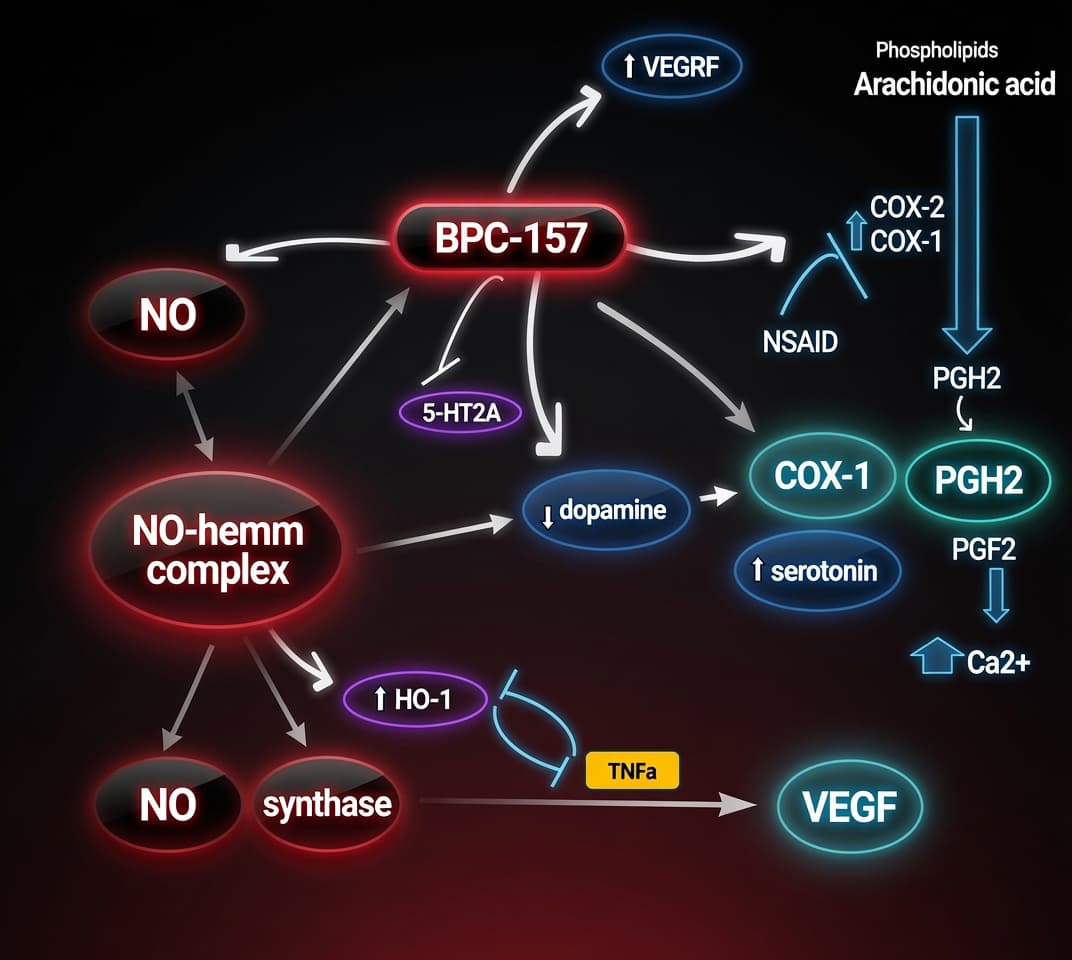
- Primary mechanisms: modulation of the nitric oxide (NO) system via upregulation of eNOS, activation of VEGFR2-Akt-eNOS signaling for angiogenesis, and enhancement of antioxidant defenses (HO-1 upregulation).[12]
- Influences >500 genes, rapidly activating ERK1/2, FAK-paxillin, and Egr-1 pathways to promote cell migration, proliferation, and ECM remodeling.[2]
- Short half-life (<30 minutes) but sustained effects via active metabolites; oral bioavailability confirmed in multiple models.[28]
- Additional effects: anti-tumor activity (Folkman’s concept), neurotransmitter modulation, and broad cytoprotective/organoprotective profile.[1]
Benefits for Gut Health and Gastrointestinal Protection
- Counteracts damage from NSAIDs, alcohol, stress, and surgical interventions by stabilizing tight junctions and reducing intestinal permeability.[7]
- Reverses alcohol-induced gastric and liver lesions with efficacy comparable to ranitidine and propranolol.[22]
- Attenuates portal hypertension and cirrhosis in bile duct ligation models.[23]
- Promotes simultaneous healing of internal and external fistulas, outperforming standard therapies.[10]
- Restores brain-gut and gut-brain axis function, with strong evidence in IBD models aligned with Robert’s and Selye’s cytoprotection concepts.[8]
Benefits for Wound Healing and Tissue Regeneration
- Accelerates all phases of wound healing: enhanced granulation tissue, collagen organization, re-epithelialization, and reduced fibrosis.[2]
- In diabetic excisional wounds, topical application outperformed PDGF-BB via Egr-1 upregulation.[2]
- Faster closure in alkali-burn and thermal injury models; counters corticosteroid-induced healing impairment.[2]
- Activates collateral pathways to bypass vessel occlusions in ischemia-reperfusion scenarios (Pringle maneuver, Budd-Chiari syndrome).[17]
Benefits for Tendon, Ligament, and Musculoskeletal Repair
- Enhances fibroblast migration, collagen synthesis, and tendon-to-bone integration via FAK-paxillin signaling.[13]
- In Achilles transection and quadriceps reattachment models, significantly improved tensile strength and biomechanical outcomes.[18]
- Restores function in disabled myotendinous junctions and counters corticosteroid damage.[5]
- Pilot human data (intra-articular, often combined with TB-500): 87.5% reported knee pain relief.[3]
- 2025 systematic reviews confirm regenerative potential in musculoskeletal models with favorable renal clearance profile.[13][18]
Anti-Inflammatory and Neuroprotective Effects
- Reduces pro-inflammatory cytokines (TNF-α, IL-6) and promotes M1-to-M2 macrophage shift.[1]
- Long-term functional recovery (up to 360 days) in spinal cord compression models.[25]
- Counteracts serotonin syndrome, amphetamine toxicity, and stroke-induced deficits in memory, locomotion, and coordination.[4][26]
- Pleiotropic modulation of neurotransmitter receptors (blockade, depletion, sensitization).[27]
Cardiovascular and Vascular Protection
- Prevents and reverses thrombosis, arrhythmias, myocardial infarction, heart failure, and pulmonary hypertension.[15][30]
- Resolves major vessel occlusions and ischemia-reperfusion injury via cytoprotection and collateral pathway activation.[21][31]
- Controls angiogenesis through NO-system balance with additional anti-tumor and free radical scavenging effects.[20][32]
Ocular Conditions and Emerging Applications
- Cytoprotective therapy in glaucoma models with vascular rescue potential.[6][33]
- Pilot improvement in interstitial cystitis symptoms (2024).[14][35]
Safety Profile
- Excellent preclinical safety: no toxicity at high doses, metabolized in liver, cleared by kidneys.[37]
- Minimal reported side effects across animal and limited human pilot data.[1]
- Investigational status: large-scale human trials still needed.
Related Peptides
- TB-500 – Complementary for enhanced tissue repair and actin regulation
- GHK-Cu – Synergistic effects on collagen synthesis, skin healing, and anti-fibrotic activity
- Wolverine – BPC-157 + TB-500 blend for enhanced recovery research
- GLOW – GHK-Cu + BPC-157 + TB-500 blend focused on skin and tissue remodeling
- KLOW – GHK-Cu + BPC-157 + TB-500 + KPV blend with added anti-inflammatory support
Frequently Asked Questions
- What is BPC-157 primarily used for? Gut health restoration, accelerated wound healing, tendon/ligament repair, and cytoprotection across multiple systems.
- Is BPC-157 safe? Preclinical and limited human data indicate minimal side effects and high tolerability.
- Does BPC-157 help with brain injuries? Yes—improves long-term recovery in models of stroke, spinal cord injury, and neurotoxicity.
- Can BPC-157 support heart conditions? Evidence shows reversal of thrombosis, arrhythmias, and ischemic damage.
Related Research Product
Researchers studying cytoprotective and regenerative peptides may find the following option useful for laboratory work.

References
- 1. Józwiak M, et al. Pharmaceuticals. 2025. PubMed
- 2. Seiwerth S, et al. Front Pharmacol. 2021. PubMed
- 3. Lee E, Padgett B. Altern Ther Health Med. 2021. PubMed
- 4. Vukojevic J, et al. Neural Regen Res. 2022. PubMed
- 5. Staresinic M, et al. Biomedicines. 2022. PubMed
- 6. Sikiric P, et al. Pharmaceuticals. 2023. PubMed
- 7. Park JM, et al. Curr Pharm Des. 2020. PubMed
- 8. Sikiric P, et al. Biomedicines. 2023. PubMed
- 9. Bajramagic S, et al. Int J Mol Sci. 2024. PubMed
- 10. Sikiric P, et al. Curr Med Chem. 2020. PubMed
- 11. Sikiric P, Hahm KB, et al. Gut Liver. 2020. PubMed
- 12. Sikiric P, et al. Curr Med Chem. 2024. PubMed
- 13. Vasireddi N, et al. Curr Rev Musculoskelet Med. 2025. PubMed
- 14. Lee E, et al. Altern Ther Health Med. 2024. PubMed
- 15. Sikiric P, et al. Biomedicines. 2022. PubMed
- 16. Sikiric P, et al. Gut Liver. 2020. PubMed
- 17. Sikiric P, et al. Curr Vasc Pharmacol. 2023. PubMed
- 18. McGuire FP, et al. Curr Rev Musculoskelet Med. 2025. PubMed
- 19. Deek SA. Med Hypotheses. 2021. PubMed
- 20. Sikiric P, et al. Curr Vasc Pharmacol. 2025. PubMed
- 21. Sikiric P, et al. World J Gastroenterol. 2022. PubMed
- 22. Prkacin I, et al. J Physiol Paris. 2001. PubMed
- 23. Sever AZ, et al. Eur J Pharmacol. 2019. PubMed
- 24. Klicek R, et al. J Pharmacol Sci. 2008. PubMed
- 25. Perovic D, et al. Curr Issues Mol Biol. 2022. PubMed
- 26. Boban Blagaic A, et al. Eur J Pharmacol. 2005. PubMed
- 27. Vukojevic J, et al. Neural Regen Res. 2022. PubMed
- 28. Sikiric P, et al. Curr Med Chem. 2024. PubMed
- 29. Józwiak M, et al. Pharmaceuticals. 2025. PubMed
- 30. Sikiric P, et al. Biomedicines. 2022. PubMed
- 31. Sikiric P, et al. World J Gastroenterol. 2022. PubMed
- 32. Sikiric P, et al. Curr Vasc Pharmacol. 2025. PubMed
- 33. Sikiric P, et al. Pharmaceuticals. 2023. PubMed
- 34. Deek SA. Med Hypotheses. 2021. PubMed
- 35. Lee E, et al. Altern Ther Health Med. 2024. PubMed
- 36. Józwiak M, et al. Pharmaceuticals. 2025. PubMed
- 37. Xu C, et al. Regul Toxicol Pharmacol. 2020. PubMed
All information presented for research and educational purposes only.